 david24232525@gmail.com
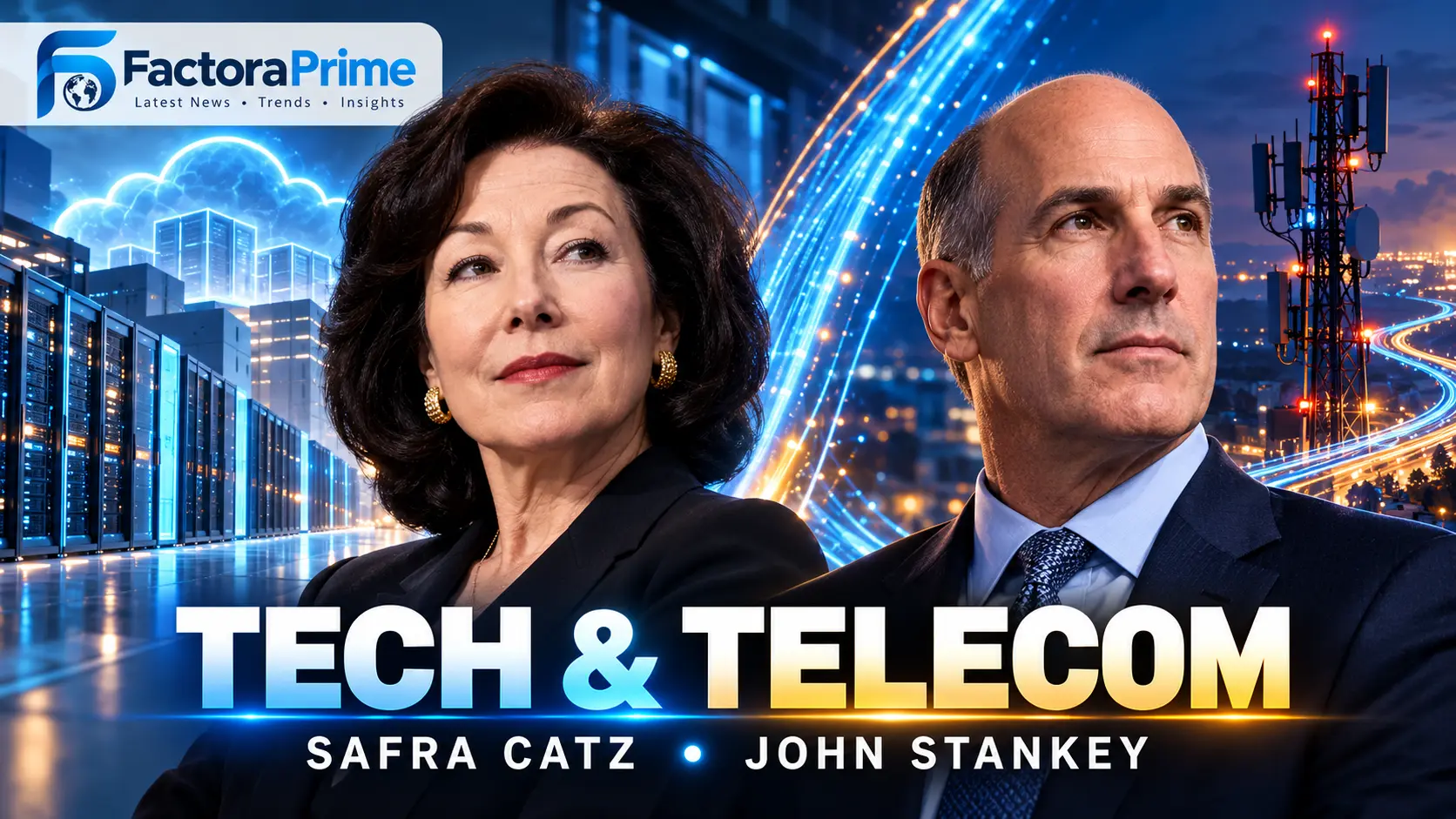
Safra Catz and John Stankey do not work together. They lead two separate corporate giants Oracle and AT&T and their connection exists primarily in the broader narrative of American enterprise: both are veteran executives navigating their companies through the artificial intelligence revolution while confronting Washington’s increasingly assertive posture toward Big Tech.
Catz, who stepped down as Oracle’s CEO in September 2025 after more than a decade at the helm, now serves as executive vice chair of Oracle’s board, continuing to influence the company’s trajectory alongside founder Larry Ellison . Stankey, a 40-year AT&T veteran, has led the telecom giant as CEO since July 2020 and was elected board chairman in February 2025, steering AT&T’s transformation into what he calls “the best advanced connectivity company” .
The pairing of their names in search queries often stems from curiosity about whether these two influential figures intersect professionally or share similar paths. The short answer is no but the longer answer reveals two distinct leadership philosophies, two different corporate survival strategies, and a shared moment in history where technology, geopolitics, and national security have become inseparable.
Safra Catz: The Operator Behind Oracle’s Cloud Gambit
From Investment Banker to Silicon Valley Powerhouse
Safra Catz was born in Holon, Israel, in 1961, and moved to the United States at age six when her father, a physicist, took a position at MIT . Her path to Oracle ran through Donaldson, Lufkin & Jenrette, where she rose to managing director in investment banking . That Wall Street discipline ruthless prioritization, financial rigor, deal-making instincts became the signature of her tenure at Oracle.
Catz joined Oracle in 1999 and became CFO in 2005. She was appointed co-CEO alongside Mark Hurd in 2014, following Larry Ellison’s decision to step back from the chief executive role . For years, she was the quiet force behind Oracle’s numbers while Ellison remained the public visionary. But when Hurd passed away in 2019, Catz became sole CEO and the company’s transformation accelerated.
The TikTok Deal and the National Security Play
Perhaps no single decision better illustrates Catz’s influence than Oracle’s role in the TikTok saga. Since 2022, TikTok has stored U.S. user data on Oracle’s cloud infrastructure, a arrangement Catz has repeatedly defended as a national security asset . In interviews, she has emphasized that “all the data of U.S. citizens is in that cloud” and that Oracle has implemented gateways to monitor and prevent unauthorized data extraction .
The arrangement evolved into something far more consequential. By late 2025, Oracle was positioned to lead a joint venture that would separate TikTok’s U.S. operations from its Chinese parent ByteDance, with American investors holding majority ownership . The deal, valued in the billions, represents both a commercial victory and a geopolitical statement: Oracle, under Catz’s stewardship, became the trusted intermediary between a foreign-owned platform and the U.S. government.
Catz has been candid about the political dimension of her work. A 2015 email to former Israeli Prime Minister Ehud Barak, later reported by Responsible Statecraft, revealed her view that “we have to embed the love and respect for Israel in the American culture” . This perspective that corporate power and cultural influence are intertwined has shaped Oracle’s positioning in Washington, where Catz and Ellison have cultivated close ties with multiple administrations .
The Billionaire Who Shunned the Spotlight
Despite her influence, Catz has maintained an unusual degree of privacy for a Silicon Valley CEO. Her wealth, estimated at over $2 billion according to Forbes, derives largely from Oracle stock options rather than her base salary . In 2017 alone, her total compensation exceeded $135 million, making her one of the highest-paid female executives in the world .
In September 2025, Catz transitioned to executive vice chair, handing the CEO role to Oracle insiders Clay Magouyrk and Mike Sicilia . The move signaled Oracle’s next phase: a sharper focus on AI infrastructure and cloud computing, with Catz remaining in a strategic role. As she told analysts, “Oracle red runs through my blood. You want to make a transition like this when things are great” .
John Stankey: The Telecom Veteran Betting on Connectivity
Four Decades at One Company
John Stankey’s career is a rarity in corporate America: he joined AT&T in 1985 and never left . Over 40 years, he has held nearly every significant leadership role in the company COO, CEO of WarnerMedia, Chief Strategy Officer, Chief Technology Officer, and CEO of AT&T Business Solutions . When he became CEO in July 2020, he inherited a company burdened by debt from ill-fated media acquisitions and facing existential questions about its place in a 5G world.
Stankey’s answer has been to refocus AT&T on its core competency: connectivity. He has overseen the spin-off of WarnerMedia (now Warner Bros. Discovery) and the divestiture of other non-core assets, simplifying a conglomerate that had grown unwieldy. His stated ambition is for AT&T to be “the best advanced connectivity company” a phrase that sounds like corporate boilerplate until you consider what it means in practice .
Fiber, AI, and the Infrastructure Nobody Sees
In a 2025 interview with Norges Bank Investment Management, Stankey laid out his thesis: AI will drive unprecedented demand for data, and the companies that own the physical infrastructure fiber, spectrum, data centers will capture durable value . “Fiber infrastructure is critical,” he said, describing AT&T’s investments as a long-term bet on the underlying plumbing of the AI economy .
This is a less glamorous vision than Oracle’s cloud ambitions, but it may be more resilient. While tech companies compete on algorithms and applications, AT&T owns the pipes through which those applications flow. Stankey’s strategy is to make those pipes faster, more reliable, and more ubiquitous.
Compensation and Accountability
Stankey’s compensation reflects the scale of the challenge. His total pay package reached approximately $30 million in 2025, with the vast majority tied to stock awards and performance metrics rather than salary . That structure aligns his interests with shareholders but it also means his financial success depends on AT&T’s stock performance, which has lagged peers for much of his tenure.
The company’s financial results have been mixed. AT&T reported net income of $22 billion in 2025, a significant improvement from the losses of previous years, but revenue growth remains modest . Stankey’s bet is that the AI-driven data boom will eventually translate into higher margins for connectivity providers. Whether that bet pays off within his tenure remains an open question.
The Common Thread: Navigating Washington
What truly connects Safra Catz and John Stankey is not a business partnership but a shared challenge: operating major American companies in an era when national security concerns increasingly dictate corporate strategy.
Catz’s TikTok involvement is the most visible example. Oracle’s role as TikTok’s “trusted security provider” was explicitly framed as a national security solution, with the U.S. government effectively blessing the arrangement . Catz has embraced this role, positioning Oracle as a bridge between foreign technology and American security interests.
Stankey faces his own version of this dynamic. AT&T’s network infrastructure is critical to U.S. communications, making it a perennial target for regulators and national security officials. The company’s relationship with the government including contracts with defense and intelligence agencies requires a level of political sensitivity that pure consumer tech companies can avoid.
Both executives have also had to navigate the Trump administration’s unpredictable approach to Big Tech. Catz and Ellison’s Republican ties gave Oracle an advantage in the TikTok negotiations . Stankey, meanwhile, has maintained a lower political profile, focusing on AT&T’s core business rather than cultivating relationships in Washington.
Comparison at a Glance
What Their Careers Reveal About American Business Today
Catz and Stankey represent two archetypes of modern corporate leadership. Catz is the deal-maker, the executive who sees around corners and positions her company at the intersection of technology and geopolitics. Stankey is the operator, the lifer who understands every corner of his organization and bets on fundamentals infrastructure, execution, long-term demand.
Neither approach is inherently superior. Oracle’s stock has performed well under Catz, driven by cloud growth and strategic wins like TikTok. AT&T’s stock has been more volatile, reflecting the challenges of transforming a legacy business in a competitive market.
But both executives share a recognition that the era of “move fast and break things” is over. Catz’s Oracle operates within a framework of national security vetting and government oversight. Stankey’s AT&T is a regulated utility in all but name, with its fortunes tied to policy decisions about spectrum, competition, and infrastructure investment.
The next few years will test whether their strategies can deliver. Oracle’s new co-CEOs will need to prove they can sustain the cloud momentum Catz built. AT&T will need to demonstrate that fiber and 5G investments generate the returns Stankey has promised. And both companies will continue to navigate a Washington that no longer views Big Tech as a neutral actor.
For Catz and Stankey, the question is not whether they will be remembered they will, as leaders of two of America’s most consequential companies. The question is whether their bets on AI, infrastructure, and national security will look prescient or cautionary when the history of this era is written