 david24232525@gmail.com
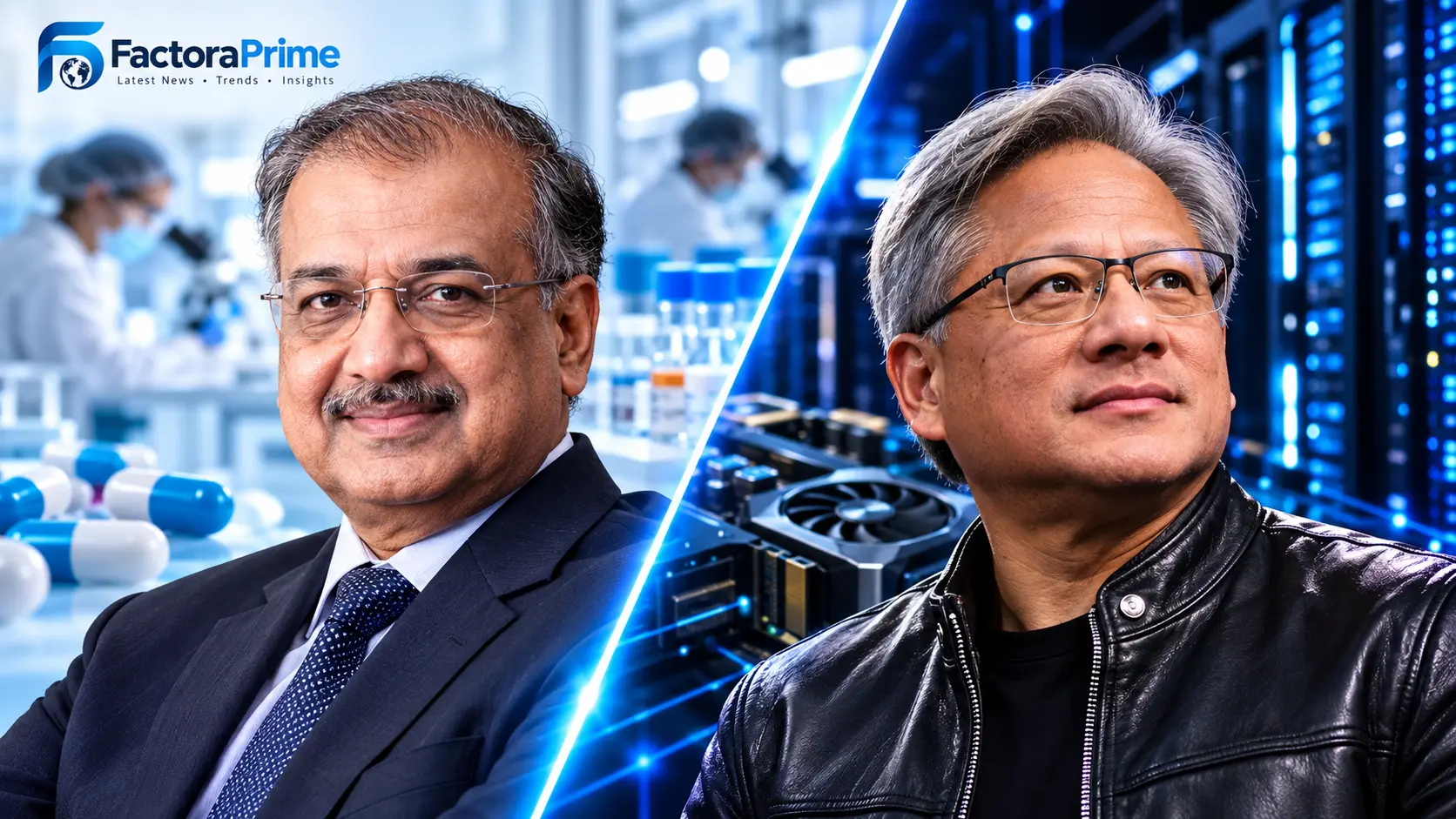
Dilip Shanghvi and Jensen Huang represent two very different paths to extraordinary wealth, with Huang holding the much larger fortune. Huang leads Nvidia, the AI-chip company that surpassed a $5 trillion market valuation in 2025, while Forbes estimates during 2026 have placed his wealth at roughly $180–197 billion. Shanghvi, founder of India’s largest drugmaker, Sun Pharma, has been valued at around $20–29 billion, depending on the source and date. Publicly available records indicate no formal business partnership between them; their names are mainly linked through billionaire rankings and wealth comparisons. This guide examines their estimated fortunes, explains why figures vary across sources, and explores what their contrasting careers reveal about building wealth.
At a glance
| Dilip Shanghvi | Jensen Huang | |
|---|---|---|
| Born | 1 October 1955, Gujarat, India | 17 February 1963, Taiwan |
| Company | Sun Pharmaceutical Industries | Nvidia |
| Founded | 1983 | 1993 (with Chris Malachowsky and Curtis Priem) |
| Role | Founder, Managing Director | Founder, President and CEO |
| Industry | Pharmaceuticals (generics and specialty) | AI chips, GPUs, data-centre computing |
| Estimated wealth | About $20 billion (Hurun 2025); $28.9 billion (Forbes, May 2025) | About $180.8 billion (Forbes, April 2026); $196.8 billion during a later rally |
| Notable honour | Padma Shri (2016) | Time 100 (2021 and 2024) |
Wealth figures are market-linked and move daily. Treat them as snapshots, not fixed facts.
Is there actually a connection between them?
Let me be direct, because this is the question most readers arrive with. I could find no verified evidence of a joint venture, shared investment, or public partnership between Dilip Shanghvi and Jensen Huang. No major newspaper or company filing I reviewed links them commercially.
So why do they appear together? There are three plausible reasons:
- Billionaire-list adjacency. Both appear in wealth rankings, and some lifestyle and net-worth websites place them in the same articles. One property-focused article about Huang’s homes, for example, simply notes that both names appear on billionaire lists while working in very different industries.
- Comparison searches. People often ask how an Indian industrialist’s fortune compares with the world’s best-known tech founder.
- Auto-suggested queries. Once a pairing starts appearing in search suggestions, curiosity feeds it.
That is not a criticism of the question. The comparison is genuinely interesting, but it should be presented as a comparison, not as a rumour of collaboration. If you see a site claiming the two have met for a deal, check for a named source and a date before believing it.
Dilip Shanghvi: the quiet compounder
Dilip Shanghvi was born on 1 October 1955. According to the Business Today billionaire profile, he began in his father’s pharmacy business before launching Sun Pharma in 1983 with just ₹10,000. Open magazine’s profile describes the early company as a two-man marketing team with a small manufacturing facility at Vapi in Gujarat.
His early strategy was contrarian. While larger Indian rivals tried to take on multinationals in established drug categories, Shanghvi focused on chronic therapies, starting with psychiatry products. Open noted that chronic medicines are now almost a fourth of India’s drug sales, which suggests the bet aged well.
The acquisition engine
Sun Pharma’s growth is inseparable from acquisitions:
- Caraco Pharma (1997): the route into the US market.
- Taro Pharmaceutical (2007): an Israeli company.
- Ranbaxy Laboratories (2014): a deal reported at about $4 billion that made Sun India’s largest pharmaceutical company.
- Later specialty deals: Wikipedia lists Ocular Technologies (2016) and Concert Pharmaceuticals (2023).
Recognition has followed. He received the Padma Shri in 2016 and the EY Entrepreneur of the Year Award in India in 2005. India Today ranked him eighth in its 2017 list of India’s most powerful people.
The financial picture
Wikipedia’s summary of Sun Pharma’s most recent full year (FY26) cites a net profit of ₹11,479 crore on revenue of ₹58,220 crore. I would verify those two numbers against Sun Pharma’s own filings before quoting them in anything formal, but they are consistent with a large, profitable business.
On personal wealth, the sources disagree, which brings us to a point nbvcxza121`worth understanding.
Jensen Huang: the platform bet
Jensen Huang was born on 17 February 1963 in Taiwan; the Hong Kong University of Science and Technology honorary-degree booklet gives Taipei as his birthplace, though some websites say Tainan. His childhood took him through Thailand and then to the United States, where he and his brother attended Oneida Baptist Institute in Kentucky. After the family reunited in Oregon, he graduated from Aloha High School at 16, while also being a nationally ranked table-tennis player, according to that same HKUST citation.
He studied electrical engineering at Oregon State University, then completed a master’s in electrical engineering at Stanford. He worked at LSI Logic and Advanced Micro Devices before co-founding Nvidia in 1993.
From gaming to AI
Nvidia introduced the GeForce GPU in 1999, which redefined gaming graphics. Fortune’s profile of Huang explains the later pivot: Nvidia expanded “up the stack” from hardware into cloud services and AI models, while tech chiefs compete to secure its GPUs for their data centres. Nvidia became the first company to reach a $5 trillion market capitalisation, in October 2025.
Forbes Australia reported Huang’s wealth rising by $15.6 billion to $196.8 billion after a strong earnings report, passing Mark Zuckerberg and Larry Ellison to become the world’s sixth-richest person. In that same report, the chief financial officer forecast revenue growth of about 70 per cent for fiscal 2028, and Huang said demand was “much greater,” constrained by supply.
Net worth: why every website gives a different number
If you have searched for either man’s fortune, you will have noticed wildly different figures. Here is why.
| Source type | Dilip Shanghvi | Jensen Huang |
|---|---|---|
| Forbes (real-time / annual) | $28.9 billion (May 2025, as cited by Wikipedia) | $180.8 billion (April 2026); $196.8 billion (later rally) |
| Hurun India Rich List 2025 | $20.3 billion, ranked seventh in India | Not applicable (India-focused list) |
| Business Today India Billionaires | About ₹1.82 lakh crore, rank 9 (28 April 2026) | Not applicable |
| Bloomberg-style trackers | Varies | About $160–166 billion in mid-2026, per one analysis |
Three things drive the gaps:
- Timing. Both men’s wealth is tied to listed shares. Business Today’s tracker showed a 7 per cent single-day move in Shanghvi’s wealth, and Huang’s Nvidia holdings swung by $15.6 billion in one session.
- Methodology. Hurun and Forbes treat holdings, exchange rates and promoter stakes differently.
- Data quality. Some low-quality sites recycle stale or invented figures. I came across pages claiming Huang is worth around $10–12 billion “according to Forbes” in 2026, which contradicts Forbes’ own real-time reporting. Ignore those.
The reliable approach is simple: use a primary ranking such as Forbes, Bloomberg or Hurun, and note the date.
The real gap: roughly an order of magnitude
Even using the most generous figure for Shanghvi and a mid-range figure for Huang, Huang is worth around six to ten times as much. That is not a verdict on talent. It reflects the economics of two industries.
Pharmaceuticals reward patience, regulatory skill and portfolio management. Margins are healthy, but approvals take years and prices face pressure from governments and insurers.
AI infrastructure has, so far, rewarded whoever controls the scarce input. Nvidia’s GPUs became the shovel in a gold rush, and wealth followed demand that outstripped supply.
My view: two wealth models, and which one is harder to copy
Here is my own opinion, offered as such.
Shanghvi’s model is compounding through discipline. Acquire distressed or undervalued assets, integrate them, and pivot gradually toward higher-margin specialty products. It is unglamorous and repeatable in principle. Many readers could study it and apply a scaled-down version.
Huang’s model is a decades-long bet on a platform that did not yet exist. Nvidia spent years building general-purpose GPU computing before AI made it essential. That is far harder to replicate, because it relies on being early, technically right and lucky about timing. As Fortune notes, critics question whether current valuations are sustainable, and Huang’s fortune is concentrated in one stock. One wealth analysis argues that if Nvidia’s shares fell 30 per cent, his net worth would fall by almost as much.
My conclusion: Huang’s wealth is larger but more fragile; Shanghvi’s is smaller but more diversified in how it is earned. Neither is “better”. If you are choosing whom to learn from as a founder or investor, I would suggest Shanghvi for process and Huang for conviction.
What readers can actually take from this
- Concentration cuts both ways. Both men hold large stakes in their own companies. Great for upside, risky for downside.
- Boring can be brilliant. Shanghvi has been described as low-profile and data-driven. His record shows visibility is not required for scale.
- Timing is part of skill. Huang’s long runway before AI demand arrived is a reminder that patience is often invisible until it pays off.
- Immigrant and outsider stories recur. Huang arrived in the US as a child and Shanghvi started with a modest sum in Gujarat. Both built from outside the established centres of their industries.
How to check figures yourself
- Open the Forbes real-time billionaires page and the Bloomberg Billionaires Index for the person.
- For Shanghvi, add the Hurun India Rich List and Sun Pharma’s stock-exchange filings.
- For Huang, check Nvidia’s SEC filings and annual proxy statement for holdings and compensation.
- Note the date and the exchange rate used.
Frequently asked questions
Have Dilip Shanghvi and Jensen Huang ever worked together? I found no verified public record of a partnership or joint investment. They operate in different industries and markets.
Who is richer, Dilip Shanghvi or Jensen Huang? Jensen Huang, by a wide margin. Forbes placed him around $181–197 billion during 2026, against roughly $20–29 billion for Shanghvi depending on the list.
What does each man’s company do? Sun Pharma makes generic and specialty medicines and sells in more than 100 countries, according to Business Today. Nvidia designs GPUs and AI computing platforms.
Why do net worth figures differ so much? Share prices move daily, and ranking organisations use different methods and dates.
Is Jensen Huang’s wealth mostly Nvidia stock? Yes. Analyses of his holdings describe nearly all of it as Nvidia equity, with real estate a tiny fraction.
Conclusion
The honest answer to “Dilip Shanghvi and Jensen Huang” is that this is a comparison, not a partnership. One built an Indian pharmaceutical leader through patient acquisitions; the other built the engine of the AI era through a long technical bet. Their fortunes differ by roughly an order of magnitude, but both stories reward the same habits: focus, long horizons and a willingness to back an unfashionable idea. Check the date on any net-worth figure, and trust primary rankings over recycled blog numbers
Read aliso:Jerry Speyer and Robert De Niro: The Proven Link Most People Miss