 david24232525@gmail.com
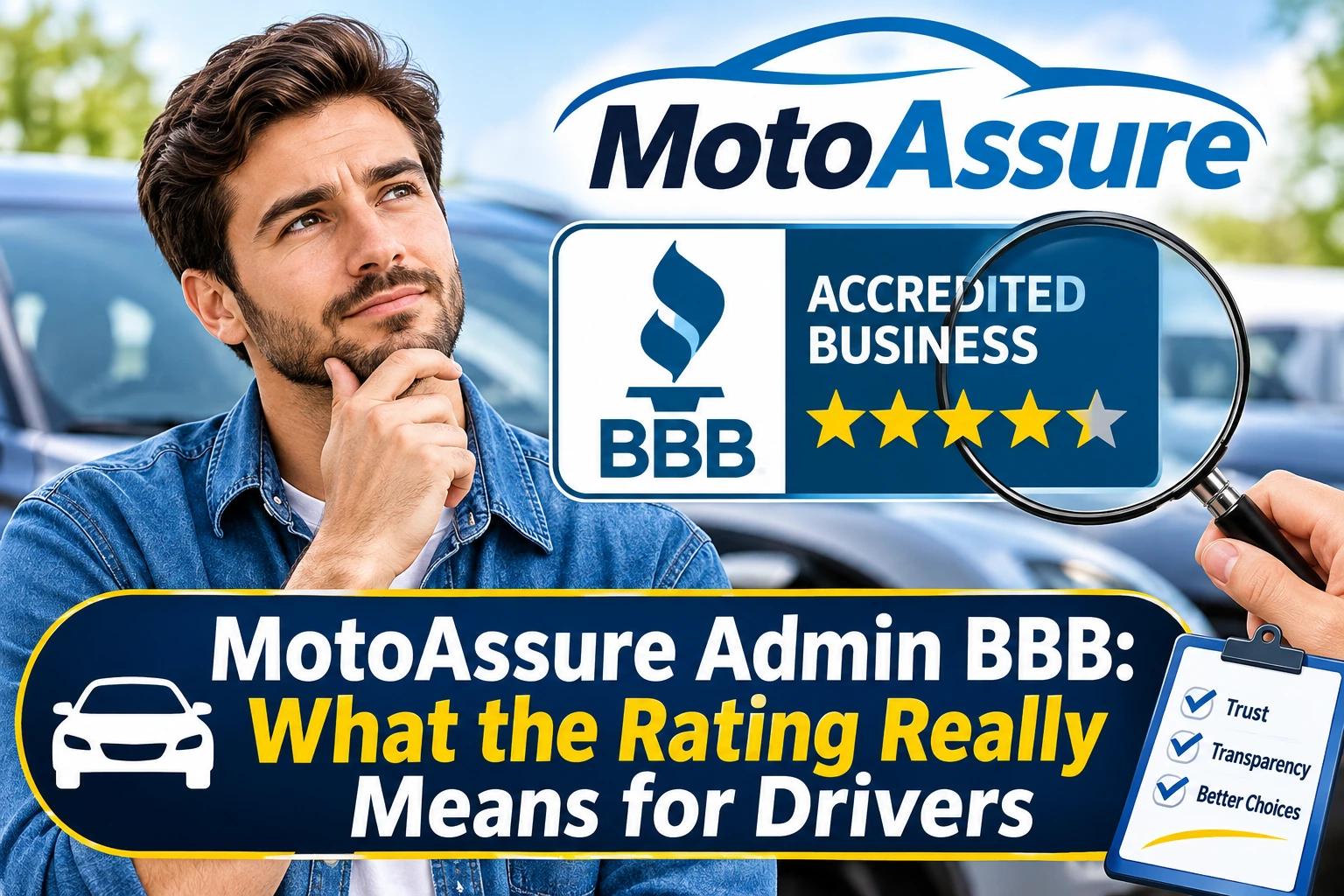
MotoAssure Admin BBB: What the Rating Really Means for Drivers
Direct Answer: Searching motoassure admin bbb usually means one of two things: you are either vetting an extended auto warranty offer before signing up, or you have already spotted a charge, claim denial, or cancellation delay tied to MotoAssure Admin and want to see how other drivers fared. Because Better Business Bureau (BBB) grades, accreditation statuses, and complaint totals shift continuously over a rolling 36-month window, no static blog post can safely quote today’s live letter grade without pulling it directly from BBB.org. What does stay reliable, however, is knowing how to decode a vehicle service contract (VSC) administrator’s BBB profile, separating surface-level letter grades from the actual complaint patterns, response timelines, and state insurance filings that protect your wallet.
In this deep-dive consumer guide, we break down what an auto warranty administrator actually does, how to audit MotoAssure Admin’s live BBB record properly, which red flags signal real trouble, and which official federal and state databases carry far more legal weight than a star rating alone.
What Is MotoAssure Admin, and Why Do Drivers Search Its BBB Profile?
If you bought a used car, answered a “vehicle warranty expiration” mailer, or reviewed a recurring monthly bank statement, seeing a name like MotoAssure Admin can feel off if it isn’t the dealership or sales agent you originally spoke with.
In the aftermarket automotive protection industry, coverage rarely comes from a single company. Instead, most third-party extended warranties (legally classified as Vehicle Service Contracts, or VSCs, rather than true insurance in most jurisdictions) split responsibilities across three separate entities:
- The Seller or Marketing Broker: The call center, online portal, or dealership finance desk that pitches the plan and collects your initial down payment.
- The Administrator (Admin): The operational hub like MotoAssure Admin tasked with managing your contract file, answering repair-shop calls, reviewing mechanical diagnostics, authorizing or denying claims, and processing cancellation paperwork.
- The Obligor or Insurer: The licensed entity or risk-retention group financially backing the contract so claims still get paid even if a marketer or administrator shuts down.
Drivers typically search MotoAssure Admin BBB at one of three friction points:
- Pre-purchase due diligence: You received a quote or contract naming MotoAssure Admin as the administrator and want to verify whether repairs actually get paid.
- Billing or cancellation friction: You tried to cancel during the contract’s “free look” period or mid-term for a prorated refund and noticed delays or unfamiliar charges.
- Repair shop claim disputes: Your mechanic called in a transmission, engine, or electrical failure, and the administrator denied coverage based on wear-and-tear exclusions or maintenance documentation.
Understanding that MotoAssure Admin sits in the administrative necessarily the sales seatis crucial. Many consumer complaints on BBB profiles stem from a disconnect between what a high-pressure salesperson promised over the phone and what the administrator is legally permitted to approve under the written contract.
How to Read the MotoAssure Admin BBB Listing Without Falling for Surface-Level Metrics
Most consumers glance at a BBB letter grade (A+ through F), skim two angry reviews, and make a snap judgment. That is a mistake, especially in the auto service contract sector, where high claim volumes naturally generate friction.
According to the Better Business Bureau’s official rating methodology, a business’s letter grade is calculated using 13 weighted factors over a 36-month window, including complaint volume relative to company size, unanswered or unresolved complaints, time in business, transparent business practices, government actions, and licensing compliance. Notably, BBB Accreditation is a paid membership status, not a government license or guarantee of claim payouts. An unaccredited company can hold an A+ rating, and an accredited company can rack up hundreds of complaints as long as it responds to them promptly.
When you pull up the live motoassure admin BBB profile on BBB.org, look past the headline grade and audit these five specific data points:
1. Match the Exact Legal Entity and Address
Warranty brokers and administrators frequently share similar-sounding names, DBAs (“Doing Business As” aliases), or outdated suite numbers. Before assuming a BBB profile belongs to your contract, compare the physical mailing address, customer service phone number, and exact corporate suffix (LLC, Inc., etc.) printed on your VSC declarations page against the “Business Details” panel on BBB.org.
2. Separate “Customer Reviews” from “Official Complaints”
On BBB.org, star-rated Customer Reviews are unmediated opinions, whereas Complaints follow a formal dispute-resolution process where the business must submit a written response. For an auto warranty administrator, the Complaint section is far more revealing. Look at the ratio of “Resolved” or “Answered” complaints versus “Unanswered” ones. If a company ignores formal BBB notices, it will likely ignore your phone calls, too.
3. Read the Nature of the Complaints, Not Just the Count
A large administrator handling tens of thousands of active contracts will inevitably receive complaints. What matters is the pattern inside the complaint narratives:
- Are disputes mostly about misunderstood exclusions (e.g., an owner trying to claim routine brake pads or pre-existing leaks)?
- Or are they about systemic stonewalling (e.g., unreturned refund checks after 90 days, vanished call centers, or arbitrary denials of covered mechanical failures)?
4. Check for “Pattern of Complaint” or “Government Action” Alerts
The BBB places bright red or yellow alert banners at the top of profiles when investigators spot recurring deceptive sales practices, state Attorney General lawsuits, or FTC enforcement actions. If an alert banner appears, read every word of it; these notices reflect formal regulatory scrutiny, not routine customer dissatisfaction.
5. Watch for Sudden Closure or Ownership Shifts
In the extended warranty industry, administrators occasionally rebrand, sell books of business, or close to new enrollments while leaving an administrative shell to wind down existing claims. Check the “Business Started” and “BBB File Opened” dates to see how long the entity has operated consistently under its current structure.
Verification Matrix: How to Audit MotoAssure Admin Beyond a Star Rating
To keep your evaluation objective, use the framework below to translate what you see on a BBB page into concrete verification steps.
| Evaluation Dimension | What You Might See on BBB.org | What It Actually Means for Drivers | Next Authoritative Step to Take |
|---|---|---|---|
| Letter Grade (A+ to F) | High grade despite negative reviews | The company responds to formal BBB tickets, even if customers remain unhappy with the policy outcome. | Read the company responses inside 10 recent complaints to see if they actually issue refunds or quote fine print. |
| Accreditation Seal | “BBB Accredited Business” badge vs. non-accredited | Accreditation confirms the business meets BBB membership standards and pays annual dues; not state solvency rules. | Verify the administrator’s and obligor’s financial backing via your State Department of Insurance (DOI). |
| Billing & Cancellation Complaints | Multiple complaints citing slow prorated refunds | Administrative bottlenecks or unclear cancellation channels between the seller and the administrator. | Submit cancellations in writing via certified mail or tracked email directly to the address in your contract. |
| Claim Denial Disputes | Denials citing “pre-existing condition” or “lack of maintenance” | Very common across all VSCs when drivers lack oil-change receipts or experience a failure shortly after purchase. | Request the exact contract clause and inspector report in writing; gather dated service records. |
| Marketing / Mailer Alerts | Complaints about “Final Notice” letters or spoofed caller IDs | Often indicates aggressive third-party telemarketers or lead brokers selling contracts administered by the company. | Check the FTC Consumer Advice guidelines on auto warranty scams and block unauthorized charges immediately. |
Common Auto Warranty Red Flags Documented by Consumer Watchdogs
Whether you are examining MotoAssure admin BBB records or comparing competing extended warranty providers, the Federal Trade Commission (FTC) and the National Association of Insurance Commissioners (NAIC) consistently warn drivers about a predictable set of industry pitfalls. Knowing these beforehand lets you spot trouble in the contract before a breakdown happens.
1. “Exclusionary” vs. “Stated-Component” Confusion
Sales agents love calling plans “bumper-to-bumper,” a phrase regulators routinely flag as misleading in aftermarket contracts.
- Stated-component (named-part) plans cover only the exact parts listed in the booklet. If a sensor, gasket, or wiring harness isn’t explicitly named, you pay out of pocket.
- Exclusionary plans cover everything except a written list of exclusions, which is much stronger, provided the exclusion list isn’t bloated with normal failure items.
2. The “Tear-Down” Risk Trap
Almost every third-party VSC contains a clause stating that you must authorizea nd pay f the mechanic to disassemble (“tear down”) the engine or transmission to determine the cause of failure. If the administrator’s inspector decides the failure resulted from overheating, sludge, or a pre-existing condition, you owe the repair shop hundreds or thousands of dollars for the tear-down alone, with zero reimbursement.
3. Maintenance Record Traps
If you change your own oil or lose paper receipts, an administrator can legally deny a major engine claim for lack of documented maintenance. Always keep digital copies of every oil change, fluid flush, and inspection tied to your VIN and odometer reading.
4. Split Refund Delays
When you cancel a policy mid-term, the administrator typically calculates the refund (minus a cancellation fee and any paid claims), then sends the unearned portion back through the original seller or financing company. When a seller and administrator point fingers at each other, consumers wait months for money they are legally owed.
My Honest Editorial Verdict: Should You Rely on BBB Alone to Judge MotoAssure Admin?
If you ask whether a BBB check is enough to completely disqualify an auto warranty administrator like MotoAssure Admin, my honest answer is no.
Here is why: The Better Business Bureau is an exceptional smoke detector, not a structural inspection.
In the vehicle service contract world, every administrator of meaningful size collects negative BBB complaints. Why? Because mechanics hate waiting on hold for claim adjusters, drivers rarely read 14-page exclusions before their transmission fails, and used cars naturally break down right after purchase, triggering inevitable clashes over waiting periods and pre-existing conditions. A handful of angry reviews does not automatically make an administrator fraudulent, just as a shiny A+ grade does not guarantee they will approve your $6,000 engine replacement without a fight.
In my view, smart drivers should apply a “Three-Pillar Verification Rule” before trusting any administrator:
- Pillar 1 B BB Resolution Quality: Look at how MotoAssure Admin responds to BBB complaints. Do they cite specific contract language, issue timely prorated refunds when cancellations are documented, and resolve billing errors? Professional, accountable responses carry real weight.
- Pillar 2: The Insurance Backing: Who actually pays if the administrator goes bust? Never buy a VSC unless the contract clearly names a licensed insurer or risk-retention obligor you can verify that insurer’s financial strength rating (such as AM Best) and state registration.
- Pillar 3: The Sample Contract First: Any reputable provider will email you the exact sample contract with exclusions, labor-rate caps, waiting periods, and cancellation terms before taking your credit card number. If a rep refuses to send the full contract PDF until after you pay, walk away immediately.
How to Verify MotoAssure Admin Using Authoritative Databases (Beyond BBB)
Because BBB is a private nonprofit, you should always cross-reference what you find on MotoAssure Admin BBB with official government and regulatory sources:
- State Department of Insurance (DOI): Most U.S. states (including California, Florida, Texas, and New York) require Vehicle Service Contract providers and administrators to register or hold a service contract provider license. Use your state DOI’s online “Company Lookup” tool to check whether MotoAssure Admin or its named obligor is authorized to operate where you live, and whether any administrative fines or cease-and-desist orders exist.
- Secretary of State Business Search: Look up the company’s legal name in its home state and your own state to confirm its “Good Standing” status, registered agent, and active corporate registration.
- State Attorney General Consumer Protection Division: State AGs maintain public press releases and searchable complaint/enforcement records. A quick search of the legal entity name alongside your state AG often surfaces investigative settlements long before consumers notice them on review blogs.
- Federal Trade Commission (FTC): Review the FTC’s official guidance on Auto Warranties and Auto Service Contracts (consumer.ftc.gov). If you experienced deceptive robocalls, spoofed dealership mailers, or unauthorized charges, filing a report at ReportFraud.ftc.gov feeds directly into federal law-enforcement databases.
- Consumer Financial Protection Bureau (CFPB): If a service contract was rolled into an auto loan at a dealership without your clear consent (“payment packing”), or if a lender fails to apply your cancellation refund to your loan principal, the CFPB handles formal complaints against auto lenders.
Already Have a Policy or Dispute? Step-by-Step Playbook for Getting ResultsIf you are researching motoassure admin bbb because you already have an active dispute, whether a denied repair or a stalled online rarely moves the needle. Follow this structured escalation process instead:
Step 1: Build an Undeniable Paper Trail
Before contacting BBB or regulators, organize a single PDF folder containing:
- Your full Vehicle Service Contract (including the declarations page and terms).
- Written denial letters or claim reference numbers (ask your repair shop for the adjuster’s name, date/time of call, and stated denial reason).
- Repair order diagnostics, fault codes, photos of failed components, and your past maintenance receipts.
- Proof of cancellation requests (certified mail return receipts, fax confirmations, or timestamped emails).
Step 2: Check Your State’s Mandatory “Free Look” & Refund Rules
Most VSCs include a 30-day review period allowing a full refund if no claims were filed. Even after 30 days, state statutes generally entitle you to a prorated refund based on time or mileage elapsed, minus a modest statutory cancellation fee. Quote the exact section of your contract in writing when requesting your refund.
Step 3: File a Factual, Solution-Focused BBB Complaint
When submitting a complaint on BBB.org, skip emotional adjectives and stick to a crisp chronological timeline:
- Date contract purchased & contract number.
- Exact issue (e.g., “Cancellation requested in writing on [Date]; 45 days elapsed without refund”).
- Desired resolution (e.g., “Issue prorated refund of $X per Section 9 of the contract”).
Businesses respond far faster to concise, documented claims than multi-page rants.
Step 4: Escalate Simultaneously to State Regulators & Your Payment Issuer
Never rely on a single channel:
- File with your State Department of Insurance and State Attorney General at the same time you file with the BBB. Companies take statutory regulator inquiries far more seriously than voluntary review sites.
- Contact your credit card issuer if you were billed without authorization, misled about the cooling-off period, or failed to receive a promised cancellation refund within the stated billing cycle. Under the federal Fair Credit Billing Act, credit cards offer far stronger dispute leverage than debit cards or ACH bank drafts.
Frequently Asked Questions About MotoAssure Admin & BBB Records
Why does my bank statement or contract show an “Admin” name instead of where I bought the plan?
Many dealerships and warranty brokers sell contracts on commission, then hand off policy servicing to a dedicated administrator like MotoAssure Admin. The administrator handles the backend database, repair approvals, and claims reserves under the terms written into your contract.
Does a good BBB rating guarantee my car repair claim will be approved?
No. A high BBB rating only shows that the business responds to formal BBB complaints and meets basic transparency criteria. Whether a specific repair gets covered depends strictly on the written exclusions, labor caps, waiting periods, and maintenance proof required by your individual service contract.
Can filing a BBB complaint force MotoAssure Admin to refund my money?
The BBB does not have legal enforcement power to force a payout. However, because accredited and reputation-conscious companies want to protect their complaint-resolution metrics, a well-documented BBB filing often reaches senior customer-relations staff who can override frontline bottlenecks, especially when paired with a State Department of Insurance complaint.
How can I cancel a vehicle service contract if the phone line puts me on endless hold?
Check the “Cancellation” section of your contract PDF. Most administrators legally accept written cancellation notices sent via USPS Certified Mail with Return Receipt Requested (along with a current odometer photo or notarized mileage statement, if required). Mail your request directly to the administrator’s official address, not just the salesperson, so your cancellation date is legally timestamped.
Final Takeaway
Searching motoassure admin bbb is the smartest first step any car owner can take before trusting a third-party extended warranty administrator with thousands of dollars in potential repair bills. Just don’t stop at the letter grade. Take ten minutes to match the exact legal entity on your paperwork, read how the company handles cancellation and claim disputes inside recent BBB complaints, verify the underlying insurer through your State Department of Insurance, and demand the full written contract before paying a single dollar. In the auto protection market, five minutes of verification upfront is worth far more than any sales promise made over the phone.
Read also : Elvis Presley and Joaquin Duato: The Shocking Truth Behind Their Connection