 david24232525@gmail.com
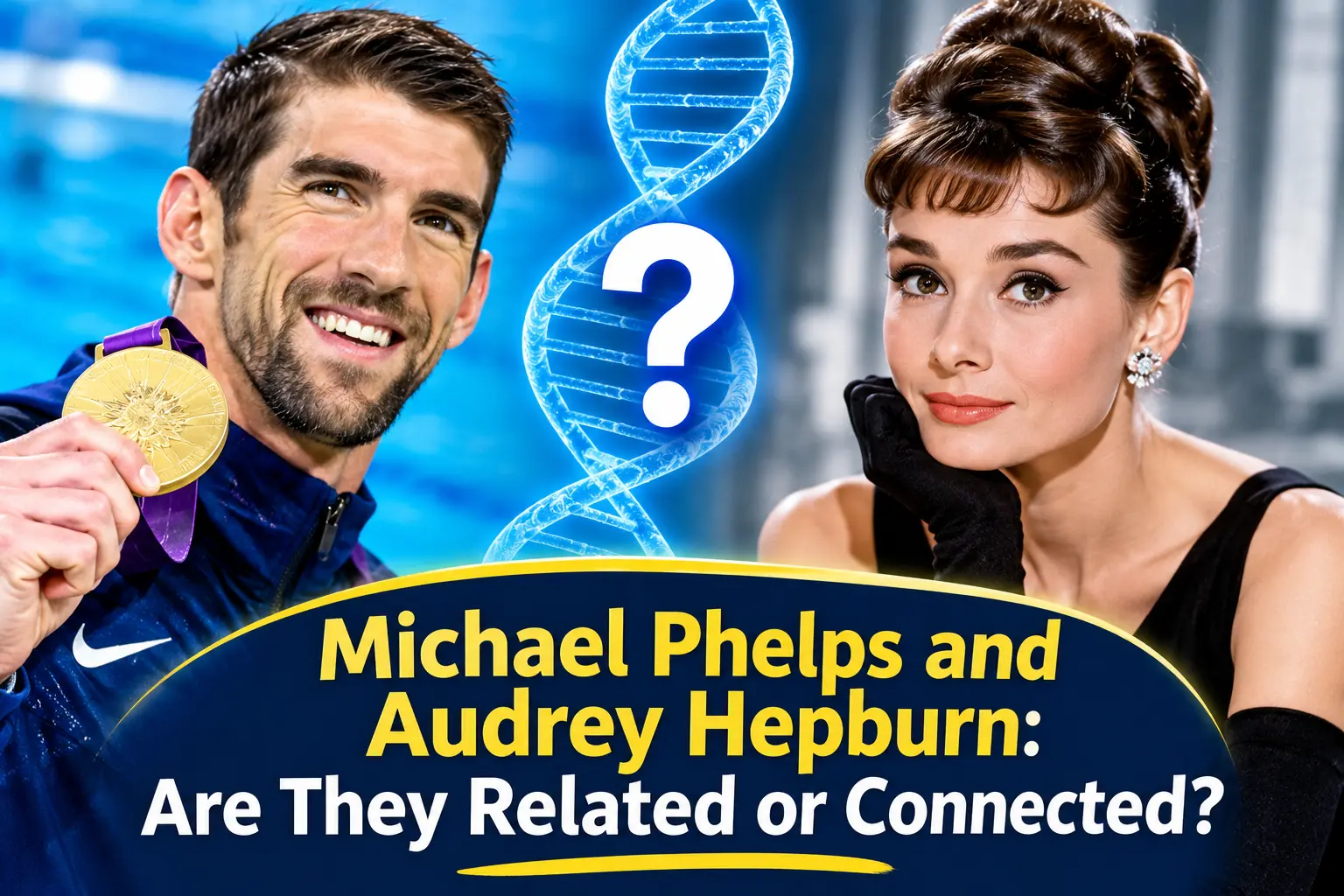
No Michael Phelps and Audrey Hepburn were not relatives, partners, colleagues or known friends. No authoritative biography, institutional archive or reputable public record documents a personal or professional relationship between them. Their lives did briefly overlap: Phelps was born on June 30, 1985, while Hepburn died on January 20, 1993, meaning he was seven years old when she died. However, Phelps did not make his Olympic debut until Sydney 2000, years after Hepburn’s acting career and UNICEF service had ended.
The interesting connection is therefore not a hidden celebrity relationship. It is the contrast between two people who achieved extraordinary mastery in completely different fields and then used their fame to support work larger than fame itself. Here is the verified timeline, the direct answer to the most common questions and the meaningful similarities between their legacies. 1
The Quick, Verified Answer
- Were they related? No documented family connection exists.
- Did they meet? No credible record establishes a meeting.
- Did they work together? No shared film, event, campaign or professional project is documented.
- Were they alive at the same time? Yes, from Phelps’s birth in 1985 until Hepburn’s death in 1993.
- What genuinely connects them? Exceptional achievement, international recognition and a decision to use public influence for humanitarian or social causes.
It is important to use precise language. Because their lifetimes overlapped, it would be impossible to prove that they never crossed paths privately. The responsible conclusion is that no notable meeting or relationship has been documented.
Michael Phelps and Audrey Hepburn at a Glance
| Category | Michael Phelps | Audrey Hepburn |
|---|---|---|
| Born | June 30, 1985, in Baltimore, Maryland | May 4, 1929, in Brussels, Belgium |
| Primary field | Competitive swimming | Film, theater and humanitarian work |
| Defining achievement | 28 Olympic medals, including 23 gold | Best Actress Oscar for Roman Holiday |
| Major career period | 2000–2016 Olympic Games | Mainly the 1950s and 1960s in film |
| Public-service legacy | Water safety, healthy living and mental-wellness education | Children’s rights and humanitarian advocacy through UNICEF |
| Documented relationship | None | None |
Phelps remains the most decorated Olympian in history, with 23 gold, three silver and two bronze medals. Hepburn received five competitive Best Actress nominations and won for Roman Holiday at the 1954 Academy Awards. She later received the Academy’s Jean Hersholt Humanitarian Award.
Why Are Michael Phelps and Audrey Hepburn Mentioned Together?
The precise origin of this unusual search pairing is not established in authoritative sources. It may have developed through a suggested search, online quiz, social-media discussion or pages created to answer the same question. But none of those possibilities should be presented as fact without evidence.
The key lesson is that two names appearing together in search results does not prove a real-world relationship. Search queries can become self-reinforcing: people see an unexpected pairing, investigate it and generate additional searches. Publishers then produce articles around the query, making the supposed “connection” look more significant than it is.
In this case, official records from Team USA, the U.S. Olympic & Paralympic Museum, World Aquatics, UNICEF and the Academy document two separate biographies. They do not identify a shared ancestor, friendship, correspondence, collaboration or public meeting.
Michael Phelps: A Career Measured in Record-Breaking Seconds
Michael Phelps entered his first Olympic Games at age 15. At Sydney 2000, he finished fifth in the 200-meter butterfly. That result did not earn him a medal, but it introduced a swimmer whose ambition would soon reshape Olympic history.
Across five Olympic appearances from Sydney 2000 through Rio 2016 Phelps accumulated 28 medals. His most famous performance came at Beijing 2008, where he won eight gold medals in a single Games. He ultimately retired after Rio with 23 Olympic golds, far more than any other athlete had won.
Numbers explain his dominance, but they do not fully explain his public importance. Phelps also spoke openly about depression, therapy and the emotional difficulty that can follow elite competition. That honesty challenged the simplistic idea that exceptional achievement protects a person from mental-health struggles.
Founded in 2008, the Michael Phelps Foundation has expanded his legacy beyond competition. Its programs combine swimming instruction and water-safety education with healthy living, goal-setting, confidence-building and mental-wellness lessons for young people.
Audrey Hepburn: More Than a Film and Fashion Icon
Audrey Hepburn was born in Brussels in 1929 to an English father and Dutch mother. After studying ballet and appearing in smaller screen roles, she achieved international stardom as Princess Ann in Roman Holiday. The performance earned her the Academy Award for Best Actress at the ceremony held on March 25, 1954.
She followed that breakthrough with acclaimed roles in films including Sabrina, Funny Face, The Nun’s Story, Breakfast at Tiffany’s, Charade and Wait Until Dark. The British Film Institute notes that her relatively concentrated run of major films helped redefine cinematic charisma and screen elegance. Her Academy record includes further Best Actress nominations for Sabrina, The Nun’s Story, Breakfast at Tiffany’s and Wait Until Dark.
Yet reducing Hepburn to a black dress, a fashionable silhouette or a collection of romantic films misses the most consequential final chapter of her life.
Hepburn became a UNICEF Goodwill Ambassador in 1988. Over the following years, she visited humanitarian and development programs in countries including Ethiopia, Turkey, Venezuela, Ecuador, Bangladesh, Viet Nam, Thailand and Sudan. She also testified before the United States Congress and used interviews and speeches to focus attention on children affected by hunger, poverty, displacement and inadequate health services.
Her work was deeply personal. Having experienced wartime hardship during childhood, she understood the importance of food and medical relief. UNICEF records that she continued working for the organization even while seriously ill in 1992. She died at her home in Switzerland on January 20, 1993.
The Timeline That Rules Out a Professional Connection
A simple chronology explains why claims of a friendship or collaboration are unsupported:
- May 4, 1929: Audrey Hepburn is born in Brussels.
- 1953: Roman Holiday makes Hepburn an international star.
- March 25, 1954: She wins the Academy Award for Best Actress.
- June 30, 1985: Michael Phelps is born in Baltimore.
- 1988: Hepburn becomes a UNICEF Goodwill Ambassador.
- January 20, 1993: Hepburn dies; Phelps is seven years old.
- 2000: Phelps makes his Olympic debut in Sydney at age 15.
- 2008: Phelps wins eight gold medals in Beijing and establishes his foundation.
- 2016: He completes his final Olympic appearance in Rio.
Their lives overlapped for approximately seven and a half years, but they were never public contemporaries in the careers that made them famous. Hepburn died seven years before Phelps entered his first Olympics.
Were Michael Phelps and Audrey Hepburn Related?
There is no documented family relationship between them. Their established family backgrounds, nationalities and generations are separate, and recognized biographical records do not identify shared ancestry.
This answer should not be complicated by unsupported genealogy theories. A genuine family connection would require evidence such as civil records, a documented family tree, correspondence or confirmation from the families. No such evidence has been established in the authoritative sources reviewed for this article.
Did They Ever Meet?
No credible public record confirms that Phelps and Hepburn met.
However, saying that a meeting was absolutely impossible would go beyond the evidence. Phelps was alive during the final years of Hepburn’s life. The dates leave open the theoretical possibility of an incidental encounter, but chronology alone cannot prove that one occurred.
The accurate formulation is therefore:
No significant meeting between Michael Phelps and Audrey Hepburn has been documented.
It would be misleading to turn a chronological possibility into a historical claim.
Did They Work on a Film, Charity Campaign or Public Event?
No. Phelps did not appear in one of Hepburn’s films, and Hepburn was not involved in his swimming career or foundation.
Their humanitarian work also occurred in different periods. Hepburn’s official UNICEF service ran from 1988 until her death in 1993. The Michael Phelps Foundation was established in 2008, 15 years after Hepburn died.
There is likewise no reliable interview in which Phelps identifies Hepburn as a direct personal or professional influence. Any claim that she inspired his career would be speculation unless supported by his own words.
What Do These Two Icons Actually Have in Common?
Although there is no direct relationship, several meaningful parallels explain why comparing them can still produce a worthwhile story.
1. Both made difficult work appear effortless
Phelps’s smooth movement through water was built on years of highly structured preparation, repetition and technical refinement. His Olympic success did not come only from physical advantages; it depended on consistency across training cycles and the ability to perform under extraordinary pressure.
Hepburn created a similar impression on screen. Her performances could appear light and spontaneous, yet her ballet training, stage experience and careful control of movement contributed to that apparent ease. The final performance concealed the labor behind it.
That is one of the strongest parallels between elite sport and acting: audiences see the finished moment, not the thousands of disciplined decisions that made it possible.
2. They changed the image of excellence in their fields
Phelps expanded public expectations of what one swimmer could accomplish across multiple events and Olympic Games. He was not defined by a single race or stroke; he won at different distances and across butterfly, individual medley, freestyle relays and medley relays.
Hepburn offered a screen presence that differed from many established Hollywood archetypes of her era. Her combination of restraint, humor, vulnerability and distinctive style influenced cinema and fashion long after her principal film career ended. Her collaboration with designer Hubert de Givenchy also became one of film history’s most recognizable relationships between an actress and a fashion designer.
3. Their public service grew naturally from their identities
The most substantial comparison concerns what happened after recognition arrived.
Phelps did not abandon swimming when he retired; he converted experience in the water into education about safety, confidence and health. His mental-health advocacy similarly grew from struggles he had experienced personally.
Hepburn’s UNICEF work was connected to her childhood memories of war and relief assistance. She did not approach humanitarian service merely as a ceremonial celebrity role. UNICEF’s record describes extensive field travel, speeches, interviews and advocacy for children.
In both cases, credible service came from lived experience rather than an unrelated endorsement.
4. Each complicated the public image of perfection
Phelps’s medals created the image of an unbeatable competitor, yet his accounts of depression demonstrated that sporting success and emotional pain can exist together.
Hepburn’s refined public image sometimes obscures a life affected by war, family disruption, professional pressure and serious illness. Her later humanitarian work revealed determination that was more demanding than the polished elegance preserved in famous photographs.
Their stories remind audiences that an icon is still a person. That may be the most human and useful connection between them.
The Differences Matter Too
A fair comparison should not flatten two very different lives.
Phelps worked in a field governed by measurable outcomes: times, places, medals and records. Hepburn worked in an interpretive art form whose influence cannot be reduced to statistics. Phelps became famous in the internet and 24-hour media era; Hepburn’s stardom developed under the classic Hollywood studio system.
Their advocacy also had different focuses. Hepburn concentrated on international children’s rights and emergency relief through UNICEF. Phelps’s foundation emphasizes water safety, swimming access, healthy living and mental wellness.
They arrived at service through different experiences, institutions and historical periods. The similarity lies in the choice to act not in the details of that action.
The Most Meaningful Interpretation of Their Legacies
In my view, searching for a secret relationship between these two figures is less interesting than understanding their “second legacies.”
Phelps’s first legacy is numerical: 28 Olympic medals and an unmatched 23 golds. His second is cultural the willingness to make vulnerability compatible with elite athletic identity.
Hepburn’s first legacy is cinematic: enduring performances and an image that continues to influence popular culture. Her second is humanitarian the decision to spend her final years directing attention toward children who possessed neither celebrity nor power.
That second legacy may ultimately be the deeper connection. Both reached the highest level of public recognition available in their professions, but neither treated recognition as the final destination.
Frequently Asked Questions
Are Michael Phelps and Audrey Hepburn family members?
No. No credible biographical or genealogical evidence establishes a family relationship between them.
How old was Michael Phelps when Audrey Hepburn died?
Phelps was seven years old. He was born on June 30, 1985, and Hepburn died on January 20, 1993, approximately five months before his eighth birthday. 1
Could Audrey Hepburn have watched Michael Phelps compete?
She could not have watched him compete at the Olympics because she died in 1993 and his Olympic debut occurred in 2000. Whether she ever encountered him privately as a child is unknown and unsupported by evidence.
Did they support similar causes?
Their causes were not identical, but both used fame to support human well-being. Hepburn advocated for children through UNICEF. Phelps’s foundation works in water safety, mental wellness, confidence and healthy living.
What is the real connection between them?
The connection is comparative, not personal. Both became internationally recognized symbols of excellence and later used their influence to benefit people beyond their original professions.
Final Verdict
Michael Phelps and Audrey Hepburn were not relatives, collaborators, romantic partners or documented friends. Their lives briefly overlapped while Phelps was a child, but no reliable evidence establishes a meeting or personal relationship.
Their names are best understood together as a study in lasting influence. One transformed Olympic swimming; the other left an enduring mark on cinema. More importantly, both demonstrated that public achievement can become a platform for service. That conclusion is less sensational than a hidden celebrity story but it is more accurate and far more meaningful.
Read also : Alysa Liu Parents: Who Are Her Dad and Mom? The Untold Family Story